Reverse Proxies Explained: The Gateway Between Visitors and Servers
Learn how reverse proxies receive requests on behalf of application servers and provide routing, TLS termination, caching, and security controls.
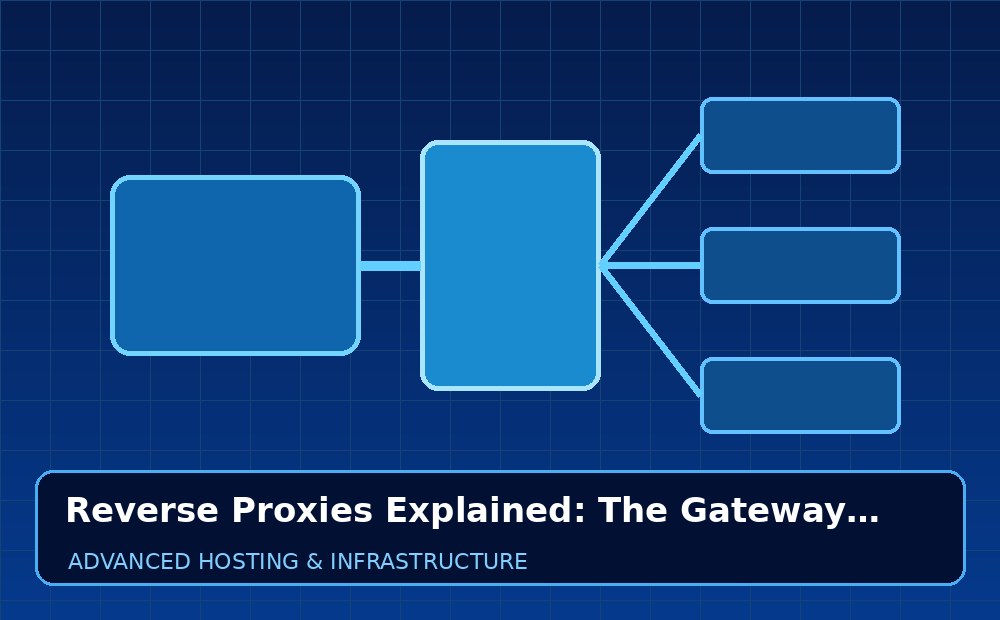
The role of this technology
A reverse proxy sits in front of one or more application servers. Visitors connect to the proxy, and the proxy forwards requests to the appropriate backend. The application servers can remain hidden from direct public access, while the proxy provides a consistent entry point for web traffic.
Reverse proxies can terminate TLS connections, route requests by hostname or URL path, apply request limits, compress responses, cache selected content, and add security headers. They can also simplify deployments by allowing backend services to change without exposing those changes to visitors.
Reverse proxy versus forward proxy
A forward proxy typically acts on behalf of a client making requests to external services. A reverse proxy acts on behalf of servers receiving requests from clients. Visitors generally interact with the reverse proxy without needing to know which backend service handles the request.
This distinction matters when planning network architecture. A reverse proxy can hide internal server details and centralize routing, while a forward proxy is commonly used to control or monitor outbound access from clients or networks.
TLS termination and routing
A reverse proxy may handle the public HTTPS connection and then forward requests to backend services. The connection from proxy to backend may also be encrypted, depending on the trust boundary and network design. Certificate management, forwarded headers, and secure backend authentication need to be configured deliberately.
Routing rules can direct requests by hostname or URL path. For example, one hostname may serve the main website while a separate path is routed to an API service. Clear rules make deployments easier, but overly broad routing or incorrect header trust can create security issues.
Logging, caching, and protection
A reverse proxy can record request metadata, enforce size limits, reject malformed requests, and apply rate limits. It may cache public content or compress responses. These controls can improve performance and help protect backend systems from unnecessary work.
Logs should be useful without collecting more personal information than necessary. Review which headers and query parameters are recorded, set retention periods, and restrict access. A reverse proxy is a powerful control point, so its configuration and software must be maintained.
Planning, monitoring, and security
Infrastructure components should be monitored as part of the complete service. Measure response time, error rates, availability, resource use, and the health of dependencies. Define who receives alerts and what actions are appropriate when a component becomes unhealthy. Keep configuration changes documented and test them before applying them to critical production systems.
Security should be built into each layer. Restrict administrative access, use strong authentication, keep software and certificates current, protect logs and secrets, and review network paths. Distributed infrastructure creates more control points, so teams need an accurate inventory and clear ownership for each service.
When this approach makes sense
Reverse Proxies Explained: The Gateway Between Visitors and Servers is most useful when the website or application has requirements that justify the added architecture and operational effort. A small informational site may not need multiple regions, complex traffic routing, or edge execution. A growing service with geographically distributed visitors, demanding availability goals, or significant traffic variation may benefit from these capabilities.
Start with measurable needs: response time, traffic volume, acceptable downtime, geographic reach, and recovery expectations. Introduce components where they solve a real problem, and avoid complexity that the organization cannot monitor or maintain.
How a reverse proxy fits into a website
A common arrangement places a reverse proxy or load balancer between the public internet and private application servers. The proxy receives the visitor's request, applies configured rules, and forwards it to the appropriate backend. The backend returns a response through the proxy, which sends it to the visitor.
This arrangement can make it easier to change application servers, host several applications behind one public address, and keep internal network details private. It also creates a central component that must be configured for capacity, availability, and secure operation.
Configuration mistakes to avoid
One common risk is trusting forwarded headers from arbitrary clients. Headers that identify the original client address or protocol should be accepted only from known proxy infrastructure. Otherwise, a visitor may be able to spoof information used for logging, access rules, or application behavior.
Other mistakes include leaving backend ports publicly accessible, using weak TLS settings, allowing oversized requests, retaining sensitive query strings in logs, and forgetting to update proxy rules when an application changes. Review configuration as part of normal software maintenance.
Key Takeaways
- Understand which infrastructure problem the technology is intended to solve.
- Consider dependencies, security, monitoring, and operational responsibilities.
- Measure the result and avoid adding complexity without a clear benefit.
Putting It Into Practice
Dyeware's Resource Center explores the technologies and architecture behind modern websites and hosting. Dyeware uses these concepts as part of its broader approach to website development and infrastructure planning. The appropriate design depends on each site's performance, security, availability, and operational requirements.