Global Edge Computing and Low-Latency Websites
Explore how edge locations process requests closer to users, reduce round-trip delays, and support globally distributed digital services.
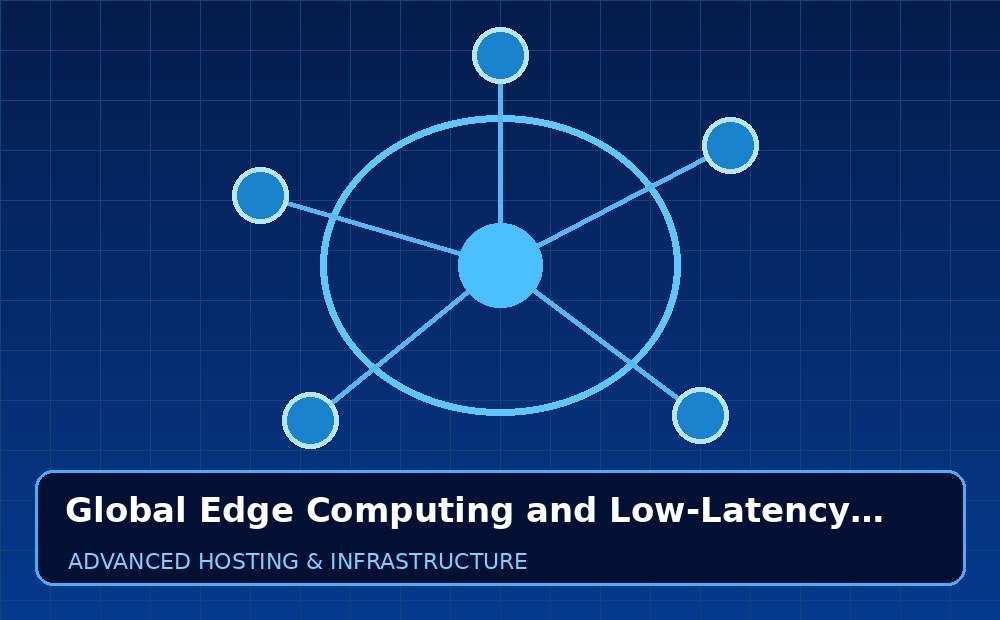
The role of this technology
Edge computing moves selected processing or decision-making closer to the people, devices, or systems that need it. Instead of sending every request to a central application environment, an edge platform may perform tasks such as request filtering, routing, content transformation, lightweight application logic, or device data processing near the point of connection.
Edge computing is not the same as simply caching a file. A CDN primarily accelerates delivery of content, while edge computing can execute code or make decisions at distributed locations. The two capabilities often work together, but they have different operational, security, and development considerations.
Latency and geographic distance
Latency is the time required for data to travel between systems and for the receiving systems to process it. Physical distance, network routing, congestion, connection setup, and application processing all contribute. A page may be hosted on a powerful server yet still feel slow to visitors far away if every request must travel to a distant origin.
Serving static resources from nearby edge locations can reduce repeated long-distance requests. Running selected logic at the edge can also avoid a round trip to a central application for certain decisions. The benefit depends on the workload and on how much processing or data access still needs the origin.
What belongs at the edge?
Good edge workloads are often small, fast, and relatively independent. Examples include redirects, header normalization, request filtering, geographic routing, lightweight personalization, and token validation. Some platforms also support more substantial functions, but execution limits and data access patterns need to be considered.
Complex business logic that depends on large databases or tightly coordinated transactions may be better placed in a central application environment. Moving code to the edge does not remove dependencies; it changes where some work happens and how distributed state is managed.
Consistency, privacy, and debugging
Distributed execution introduces questions about configuration rollout, version consistency, logging, and data location. Teams need to know which code version is active at each edge location and how quickly changes propagate.
Privacy and regulatory requirements also matter. Edge processing may occur in different geographic regions, so organizations should understand provider routing and data-handling options. Distributed logs and traces are essential when a request passes through multiple edge and origin components.
Planning, monitoring, and security
Infrastructure components should be monitored as part of the complete service. Measure response time, error rates, availability, resource use, and the health of dependencies. Define who receives alerts and what actions are appropriate when a component becomes unhealthy. Keep configuration changes documented and test them before applying them to critical production systems.
Security should be built into each layer. Restrict administrative access, use strong authentication, keep software and certificates current, protect logs and secrets, and review network paths. Distributed infrastructure creates more control points, so teams need an accurate inventory and clear ownership for each service.
When this approach makes sense
Global Edge Computing and Low-Latency Websites is most useful when the website or application has requirements that justify the added architecture and operational effort. A small informational site may not need multiple regions, complex traffic routing, or edge execution. A growing service with geographically distributed visitors, demanding availability goals, or significant traffic variation may benefit from these capabilities.
Start with measurable needs: response time, traffic volume, acceptable downtime, geographic reach, and recovery expectations. Introduce components where they solve a real problem, and avoid complexity that the organization cannot monitor or maintain.
Examples of edge-enabled services
An edge platform might redirect visitors to a regional site, reject requests that fail basic security checks, transform image formats, validate a signed token, or select a backend based on request attributes. In connected-device environments, edge systems can also process sensor data locally when sending every measurement to a central cloud service would add delay or cost.
These examples share a common idea: perform a limited task near the source or destination of the request. The edge is not necessarily a replacement for the central application. It is another execution location that can improve responsiveness or reduce unnecessary traffic when used selectively.
Tradeoffs and design questions
Distributed code needs version control, staged deployment, observability, and rollback procedures. A function that works in a central server environment may not work at the edge if the runtime has different libraries, memory limits, execution time limits, or access to persistent storage.
Ask whether the task truly benefits from being closer to the visitor. Measure end-to-end latency before and after deployment, including the time spent contacting central services. If most of the work still depends on a distant database, moving a small part of the request to the edge may produce only a modest improvement.
Key Takeaways
- Understand which infrastructure problem the technology is intended to solve.
- Consider dependencies, security, monitoring, and operational responsibilities.
- Measure the result and avoid adding complexity without a clear benefit.
Putting It Into Practice
Dyeware's Resource Center explores the technologies and architecture behind modern websites and hosting. Dyeware uses these concepts as part of its broader approach to website development and infrastructure planning. The appropriate design depends on each site's performance, security, availability, and operational requirements.