The Evolution of Microprocessors: From Early Chips to Modern CPUs
The processor transformed computing by putting the central logic of a computer onto a chip. Its history is a story of integration, architecture, performance, and changing design priorities.
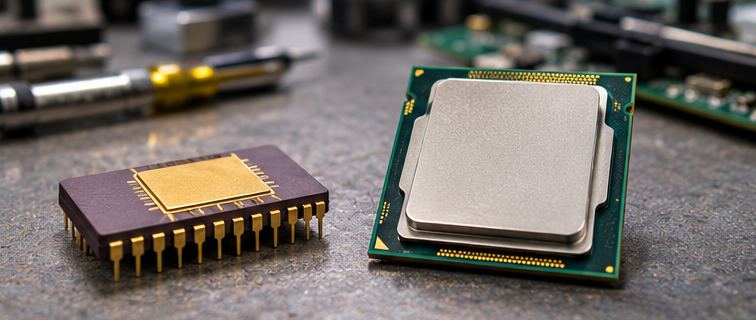
What a Microprocessor Does
A microprocessor is a programmable electronic device that executes instructions. In a general-purpose computer, the central processing unit fetches instructions from memory, decodes them, performs operations, and moves data between registers, memory, and other parts of the system. The processor is often described as the computer’s brain, although a complete computer also depends on memory, storage, input/output controllers, software, and many supporting components.
Before microprocessors, central processing functions were built from multiple integrated circuits or discrete components. Putting the CPU functions onto one chip reduced the number of separate components needed for a computer and made smaller, less expensive systems practical. It also gave manufacturers a reusable building block that could be incorporated into calculators, terminals, controllers, and eventually personal computers.
The microprocessor did not instantly make computers simple or inexpensive. Early chips had limited word sizes, memory addressing, and performance. But the ability to improve a processor generation by generation while keeping a broadly recognizable programming model helped create a rapidly expanding industry.
The First Microprocessors
Intel introduced the 4004 in 1971. It was a 4-bit processor originally designed for calculator applications and contained roughly 2,300 transistors. Its capabilities were modest by modern standards, but it demonstrated that a processor could be integrated onto a single silicon chip. The 4004 was followed by more capable processors such as the 8008 and 8080, which expanded the possibilities for control systems and early computers.
Other companies developed competing architectures. The MOS Technology 6502 became important in affordable personal computers and game systems, while Zilog’s Z80 appeared in many popular home and business computers. These processors differed in instruction sets, registers, performance, cost, and the surrounding hardware they required. Their competition helped make microcomputing more accessible.
The early market was not a simple march toward one universal processor. Designers made different tradeoffs, and software written for one processor family generally needed to be adapted or rewritten for another. The architecture chosen by a computer manufacturer could influence its software library and long-term compatibility.
The 8086, IBM PC, and the x86 Era
Intel’s 8086, introduced in 1978, established the foundation for the x86 instruction-set family. The related 8088 used an external 8-bit data bus and was selected for the original IBM PC in 1981. IBM’s success helped make the architecture influential, and later processors extended it while maintaining compatibility with a large body of existing software.
Compatibility became a powerful commercial advantage. Customers and businesses had invested in applications, data, training, and peripherals. A new processor that could run established software offered a smoother upgrade path than a completely unrelated design. This helped x86 remain central to desktop and server computing even as internal processor designs became much more sophisticated.
Other processor families also remained important. Motorola’s 68000 family powered early Macintosh computers and workstations, while RISC designs gained attention in workstations, embedded systems, and later mobile devices. Processor history is therefore a story of competing approaches rather than one uninterrupted line.
Transistors, Manufacturing, and Moore’s Law
Microprocessors became more capable as manufacturers learned to place more transistors on each chip and make those transistors smaller. Higher transistor counts allowed more complex logic, larger caches, more execution units, and integrated features. Improvements in semiconductor materials, lithography, process control, and chip design all contributed.
Moore’s Law began as an observation about the pace at which the number of components on integrated circuits was increasing. It became a planning guide for the semiconductor industry, but it was never a guarantee that every aspect of computing performance would double on a fixed schedule. Transistor density, clock speed, power use, cost, and application performance are related but different measures.
The benefits of shrinking transistors also came with engineering challenges. Leakage, heat, manufacturing variation, interconnect delays, and power density became increasingly important. A chip with more transistors could offer new capabilities, but designers had to manage how those transistors were powered, cooled, and used efficiently.
Why Clock Speed Stopped Telling the Whole Story
For many years, consumers could compare processors by looking at clock speed, measured in megahertz or gigahertz. Higher frequency often meant a processor could perform more clock cycles each second, and successive desktop processors pushed clock speeds upward. But clock frequency alone never described how much useful work a processor completed per cycle.
As frequency and transistor density increased, power consumption and heat became major constraints. Raising clock speed could require substantially more power and more demanding cooling. Manufacturers increasingly focused on improving performance per watt, doing more work per clock cycle, adding cache, and using multiple processing cores rather than relying only on ever-higher frequencies.
This is why a modern processor with a lower clock speed than an older chip may still be much faster. Architecture, instructions per cycle, core count, memory access, thermal limits, and software optimization all matter. A benchmark or real application workload is more informative than a single frequency number.
Multicore Processors and Parallel Computing
A multicore processor contains more than one CPU core on a single chip. Each core can execute instructions, allowing a computer to handle multiple tasks concurrently or divide a suitably designed workload among cores. This can improve responsiveness and throughput, particularly when software is written to use parallel execution.
Adding cores does not automatically make every program proportionally faster. Some tasks are inherently sequential, and parallel programs need to coordinate work, share data, and manage synchronization. A workload may also be limited by memory bandwidth, storage, network access, or another component. The best results come when software and hardware are designed together.
Parallel processing also appears beyond the CPU. Graphics processing units contain many smaller processing units suited to highly parallel workloads. Specialized accelerators can handle video encoding, machine learning, encryption, and other tasks. Modern computers increasingly combine several kinds of processing resources rather than relying on one general-purpose chip to do everything.
RISC, ARM, and Energy-Efficient Computing
Reduced Instruction Set Computing (RISC) approaches emphasized a comparatively streamlined instruction set and designs that could execute instructions efficiently. ARM processors became especially important in embedded systems and mobile devices, where power consumption and battery life are critical. Over time, ARM-based systems expanded into servers, laptops, and other computing environments.
The contrast between RISC and CISC is useful historically, but modern processors blur simple labels. Complex instruction sets can be translated internally into simpler operations, and RISC processors can include sophisticated execution machinery, caches, and prediction. Real-world performance depends on the complete design and software ecosystem, not just the instruction-set category.
Mobile computing placed new emphasis on energy efficiency. A phone processor must deliver responsive performance while operating within strict limits for battery capacity, heat, and physical size. System-on-chip designs combine CPU cores, graphics, memory controllers, image processing, wireless functions, and other components to reduce size and power demands.
The Modern Processor: More Than a CPU
Modern processors are complex systems. They may include multiple CPU cores, several cache levels, integrated graphics, memory controllers, security features, and specialized accelerators. Some systems combine chiplets or multiple dies in one package. Packaging and interconnect technologies are increasingly important as manufacturers look for ways to improve performance and manufacturing flexibility.
Performance is now a balance among speed, parallelism, power efficiency, heat, memory, software, and cost. A high-end desktop processor, a phone system-on-chip, and a server CPU may use different designs because they serve different needs. There is no single best processor for every workload.
The next stage of processor development will likely combine continued improvements in manufacturing and packaging with more specialized computing. Artificial intelligence workloads, graphics, scientific computing, and data processing are driving demand for accelerators and high-bandwidth memory. The central challenge remains familiar: deliver more useful computing while managing energy, complexity, and cost.
References and Further Reading
Putting technology to work for your business
Understanding the technology behind the systems we use helps businesses make better decisions about websites, hosting, data, and online operations. Dyeware provides website development and managed hosting services.